When we talk about rainwater, we usually focus on volume – how many litres are in the rainwater tank. But for the health of your home’s plumbing and the longevity of your appliances, the quality of that water is just as important.
Specifically, we need to talk about Water Hardness.
In this guide, we’ll break down what rainwater hardness actually is, how it compares to other water sources, and why your choice of tank material might be changing your water chemistry more than you think.
What is Water Hardness?
Water “hardness” refers to the concentration of dissolved minerals, specifically calcium and magnesium.
-
Hard Water: High in dissolved minerals. It’s notorious for leaving white, chalky “limescale” on taps and making it difficult for soap to lather.
-
Soft Water: Low in dissolved minerals. It feels “slippery” on the skin and is incredibly gentle on pipes and appliances.
Is Rainwater Hard or Soft?
By nature, rainwater is soft. When water evaporates from the ocean or ground, it leaves minerals behind. It falls as nearly pure, distilled water. However, the moment it hits your roof and travels to your tank, its chemistry begins to change.
The Hardness Scale (mg/L of $CaCO_3$)
According to the Australian Drinking Water Guidelines, water is classified based on its concentration of Calcium Carbonate ($CaCO_3$):
| Classification | Hardness Range (mg/L) | Typical Source |
| Soft | 0 – 60 | Rainwater (Directly from clouds) |
| Good Quality | 60 – 200 | Best for household use |
| Hard | 200 – 500 | Groundwater / Bores |
| Severe Scaling | > 500 | Arid region bores |
How Your Tank Material Affects Hardness
One of the most surprising facts for homeowners is that your tank can change your water hardness.
1. Polyethylene (Poly) Tanks
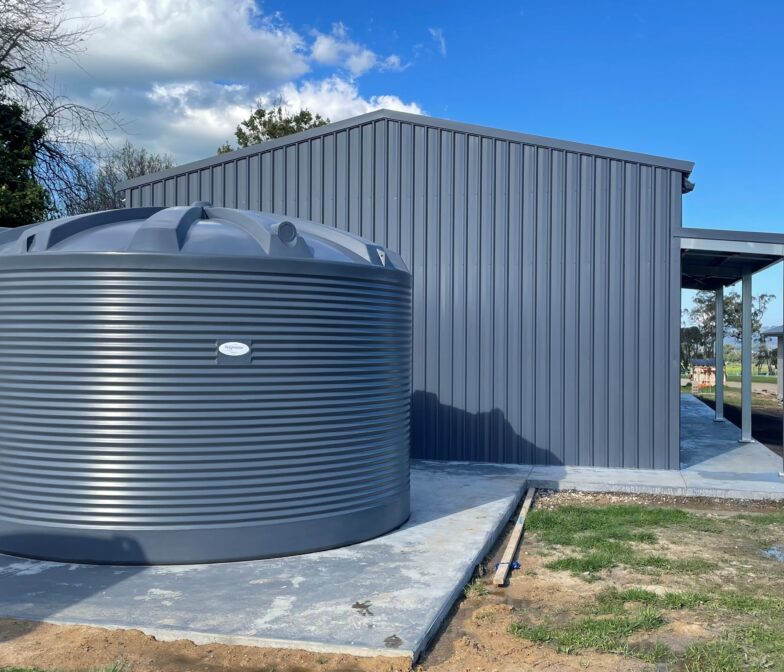
Polymaster tanks are made from food-grade, UV-stabilized polyethylene. This material is inert, meaning it does not react with the water.
-
Result: Rainwater stored in a poly tank remains Soft. This is ideal for laundry and hot water systems.

2. Concrete Tanks
Concrete is made with lime and calcium. Because rainwater is naturally slightly acidic (due to absorbed CO2 from the air), it can slowly “leach” minerals out of the concrete walls.
-
Result: Water in concrete tanks often becomes Harder over time. While this can slightly neutralize the acidity, it also increases the risk of scale buildup in your kettle or hot water service.
Why Soft Rainwater is a “Win” for Your Home
Using soft rainwater from a Polymaster tank offers several “hidden” financial benefits:
1. Appliance Longevity
Hard water is the #1 enemy of hot water systems. In hard water areas, magnesium and calcium bake onto heating elements, creating an insulating layer of scale. This makes the unit work harder, increasing your energy bills and eventually causing the element to burn out.
-
The Soft Water Advantage: With soft rainwater, your elements stay clean and efficient for years longer.
2. Better Laundry & Cleaning
Have you ever noticed that you need half a cup of detergent to get bubbles in some areas, but just a teaspoon in others? That’s hardness at work. Hard water “neutralizes” soap, turning it into a sticky scum rather than suds.
-
The Soft Water Advantage: You can use up to 50% less detergent and still get cleaner, softer clothes.
3. Gentle on Hair and Skin
Soft water doesn’t strip the natural oils from your skin or leave mineral deposits in your hair. Many people find that switching to rainwater showers helps with dry skin and eczema.
The “Downside” of Soft Water: Acidity and Corrosion
Because rainwater is so pure and soft, it can be slightly “hungry” or corrosive. Since it lacks minerals, it may try to pull them from your copper pipes or brass fittings.
The Solution:
If you notice a blue/green stain on your white porcelain sinks, your water might be too “aggressive.” To fix this, you can:
-
Add a small amount of limestone chips to the bottom of the tank to “buffer” the water.
-
Ensure your plumbing uses high-quality, corrosion-resistant fittings.
Summary: The Polymaster View
At Polymaster, our goal is to provide Measurement Honesty and water security. Understanding that your rainwater is naturally soft allows you to treat your home to the best quality water possible. By choosing an inert Poly tank, you ensure that the pure, soft quality of the rain is preserved from the moment it hits your roof to the moment it comes out of your tap.
More Similar News
View all News
Benefits of drinking rainwater
What Is the Best Base for a Water Tank?