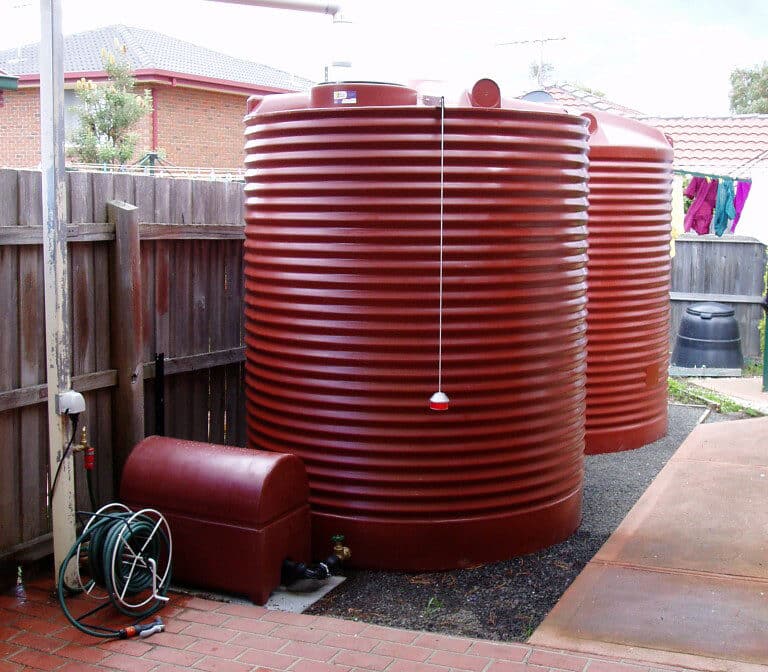
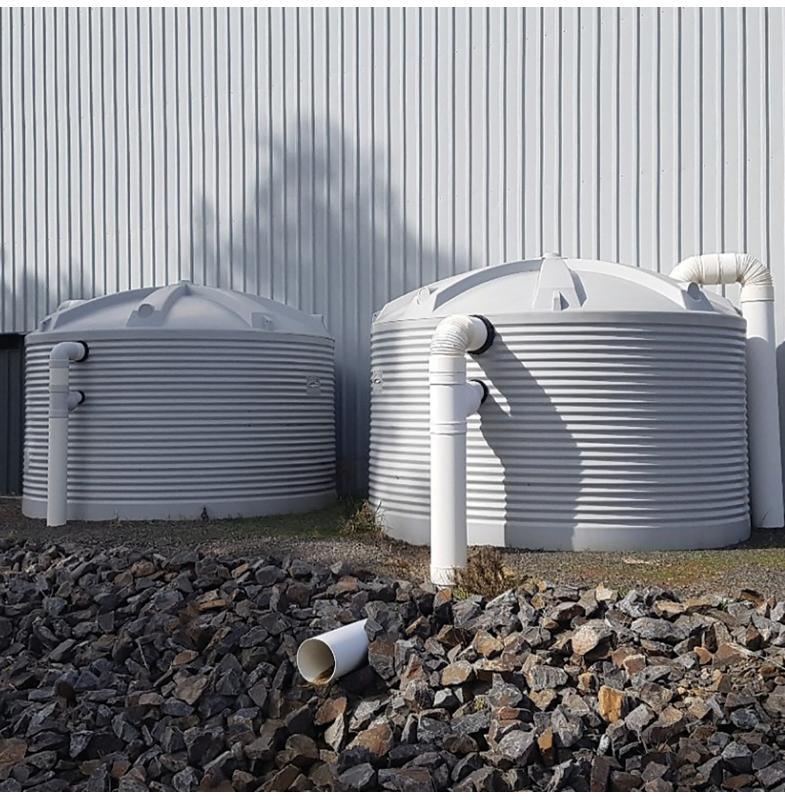
Retention tanks store water for reuse, detention tanks temporarily hold stormwater and release it slowly into the drainage system, and underground tanks maximise space by keeping storage out of sight below ground.
Each serves a different purpose, and choosing the right one depends on your property and your council’s requirements.
What Are Retention Tanks?
A retention tank captures rainwater and holds it for ongoing use. The water is stored and used for toilets, laundry, garden irrigation, or household supply.
Water stays in the retention tank until you use it. This makes retention tanks a genuine resource, not just a flood management tool. For Australian households looking to reduce mains water reliance, a retention tank is the most direct way to put collected rainwater to work.
- Retention tanks are suitable for:
- Toilet and laundry supplies in residential homes
- Garden and irrigation use on residential and rural properties
- Supplementing the mains supply during dry periods or water restrictions
- Rainwater harvesting as part of a sustainable building design
Polymaster’s round rainwater tanks and slimline tanks are common choices for retention applications, available from 200L to 50,000L and manufactured from food-grade polyethylene certified to AS/NZS4020.
What Are Detention Tanks?
A detention tank, often referred to as an On-Site Detention (OSD) system, is designed to temporarily hold stormwater runoff and release it back into the public drainage network at a slow, controlled rate. The tank does not store water for reuse. Its job is to manage flow, not supply.
During a heavy downpour, every roof in a suburb feeds into the stormwater system at once. Without intervention, this can overwhelm drains and cause localised flooding. A detention tank absorbs the initial surge and releases it gradually via a restricted outlet fitting, typically a smaller pipe or orifice plate, after the peak has passed.
Polymaster’s retention and detention tanks include a fitting positioned up the side wall that connects to stormwater. This automatically releases water over time, keeping the tank ready to capture the next rainfall event.
- Detention tanks are typically required for:
- New residential developments where the impervious surface area has increased
- Medium-density housing on previously single-dwelling blocks
- Commercial and industrial sites with large roof areas
- Any development where council stormwater requirements apply
Underground Tanks Explained
Underground tanks solve a different problem entirely: space. Where there is no room for an above-ground tank, or where aesthetics are a priority, burying the tank is the answer.
- The practical benefits are significant:
- No above-ground footprint, leaving yard and garden space free
- Water stays cool and protected from UV exposure and algae growth
- Tanks can be interconnected to increase total holding capacity
- Compatible with a submersible pump for delivery to taps or irrigation
Polymaster underground tanks carry a 10-year manufacturer’s warranty and a 15-year design service life. Installation requires a qualified plumber and licensed electrician.
How Councils Use These Systems
Councils across Australia are increasingly requiring stormwater management tanks as part of development approvals. As urban density increases and more natural ground is replaced with hard surfaces, the pressure on public drainage grows.
Detention systems are the most commonly mandated solution, requiring that new builds reduce the rate at which stormwater enters the public network. In many cases, the required volume and release rate are specified precisely in the development approval conditions.
Retention systems may also satisfy council requirements while delivering additional benefit, since stored water can be put to productive use rather than simply delayed and discharged.
All certified Polymaster tanks can be modified to meet council specifications Australia-wide. Polymaster’s team can confirm the correct fitting configuration to ensure compliance with your specific council’s requirements.
Which Option is Right for You?
The right choice depends on your property type, council requirements, and how you intend to use the water.
- Harvest rainwater for household or garden use: a retention tank is the right fit. Round or slimline above-ground poly tanks are the most practical choice for most residential and rural properties.
- Council requires an OSD system: you need a detention tank configured with the correct restricted outlet fitting to meet the specified release rate.
- Limited above-ground space or strict aesthetic requirements: an underground tank resolves both issues while still providing meaningful storage capacity.
- Development needs to meet both reuse and flood management requirements: a hybrid system combining retention and detention functions within a single tank is an option worth discussing with your plumber or council engineer.
The requirements vary by state and council area, so it is always worth confirming the specifications before purchasing.
Final Thoughts
Whether you are harvesting rainwater, managing stormwater runoff to meet council compliance, or working with a tight urban site, there is a poly tank solution designed for the job.
Polymaster manufactures all three tank types from Australian-made, food-grade polyethylene, certified to AS/NZS 4766 and available through over 1,600 agricultural and plumbing stores nationwide. Contact our team to discuss which tank suits your property.
More Similar News
View all News
What Are Rainwater Tanks Used For?
How Much Space Do You Need for a Water Tank?