




Tank Base Preparation
Home Knowledge Centre Resources Tank Base Preparation
HOW TO PREPARE A WATER TANK BASE
Water Tank Base Preparation
Depending on size, a full Polymaster tank can weigh up to 50 tonnes. Everything under it has to carry that load, evenly, for decades.
In the rare event of trouble with a tank, it can nearly always be traced back to an unstable base. Get this right and the tank sits level, the fittings stay put and the warranty stands.
Get it wrong and the warranty is void.
Who prepares the base
Correct installation is the responsibility of the purchaser. Polymaster does not install tanks.
Our drivers deliver and unload, but they don’t build bases, position tanks onto pads or connect plumbing. The base needs to be finished and cured before the tank arrives, and any plumbing should be handled by a licensed plumber.

BASE REQUIREMENTS
What the base has to be
600mm larger in diameter
The base must extend at least 600mm past the tank on every side. This is a bigger margin than most manufacturers require, and it’s the requirement people most often get wrong. A tank with its edge on the pad boundary will settle unevenly.
75mm to 100mm compacted
Level sand or equivalent, in stable soils. Compact it thoroughly rather than spreading and levelling, since loose material looks flat and then settles under load.
Exactly level and flat
Not close enough. Check with a straight edge and a level across the pad both ways. A tank that sits off level loads unevenly and puts strain on the outlet.
A-grade material, nothing sharp
No rocks, stones, sharp objects or foreign matter. Anything hard and pointed under a poly tank becomes a pressure point with tonnes on top of it.
Retain the edges
The outside of the base must be supported by a retaining wall of some kind, so nothing can undermine the base through washout, vermin or anything else. Sleepers, concrete edging or similar all work.
This is the step most often skipped and the one that causes the most trouble later.
 Failure to provide a stable base will void your warranty.
CHOOSING A BASE MATERIAL
Choosing a base material
Several materials meet the requirements. Which one suits depends on your tank size, the ground you’re working with and what you can get delivered.

Compacted sand
The installation guide specifies 75mm to 100mm of level sand or equivalent in stable soils.
Straightforward and widely available, and it needs retaining and covering once the tank is in place.
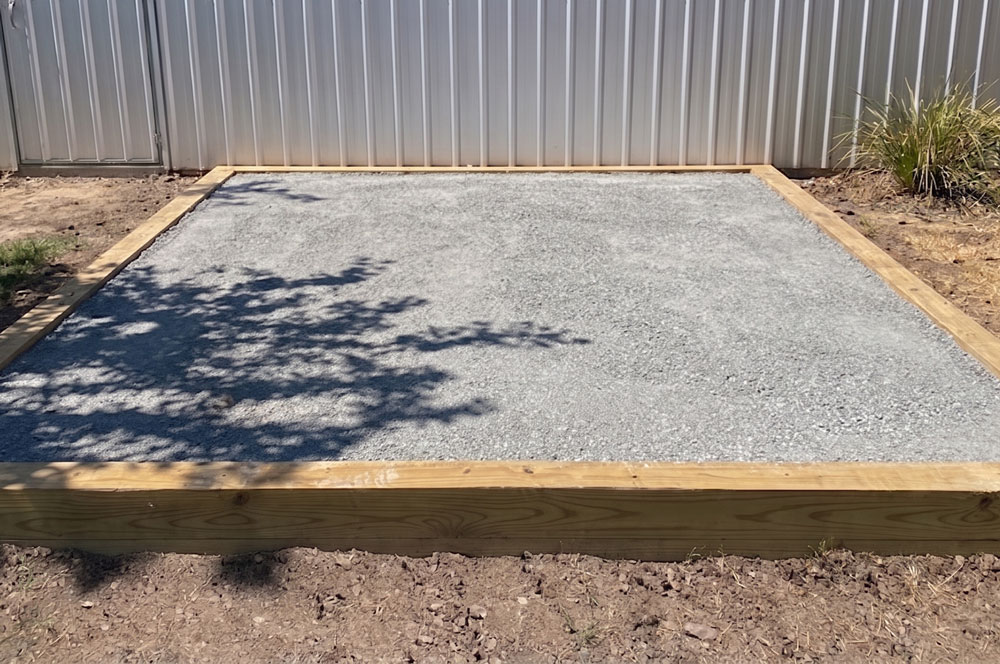
Crusher dust base
Binds tightly when compacted and gives a smooth, stable pad with good drainage.
Same requirements apply: compacted, level, retained at the edges and free of anything sharp.
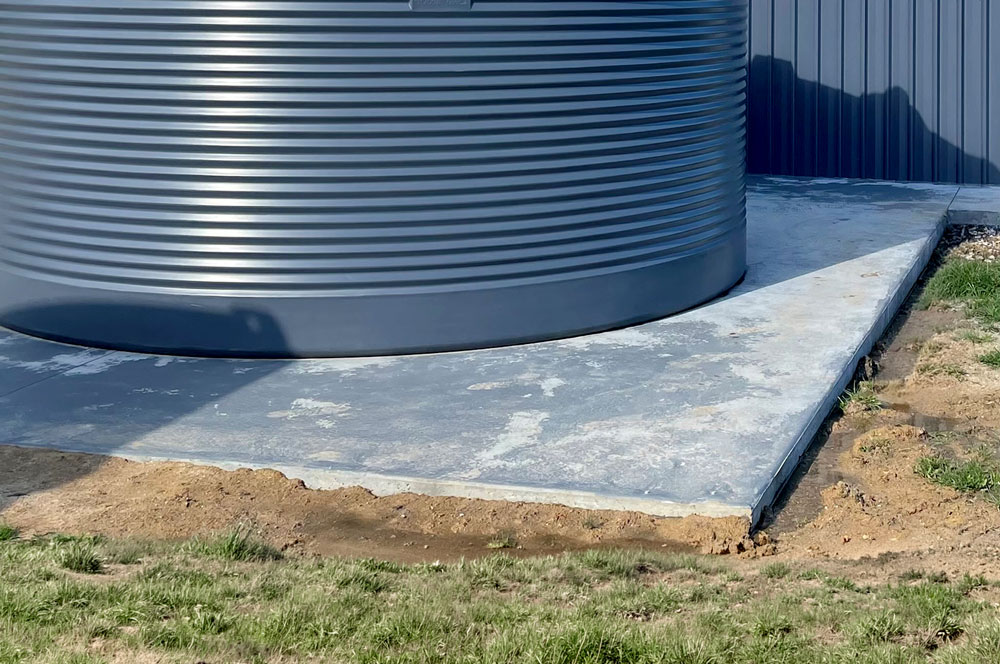
Concrete pad
Stable, durable and won’t erode. Suits larger tanks and poorer ground.
Costs more and takes longer, since the slab needs to cure before the tank goes on it.
Other consolidated fill
Other compactable fill works provided it’s A-grade, free of rocks and sharp objects, and properly compacted.
If in doubt, ask your supplier what it’s rated for.
PREPARING THE SITE
Preparing the site, step by step
Pick the spot
Allow for a base 600mm larger in diameter than the tank.
Check delivery access at the same time, since the truck has to get there before the tank can go anywhere.
Clear the ground
Remove turf, soft topsoil, roots, rocks and debris.
Build on undisturbed ground rather than on organic material that will break down under load.
Cut in rather than build up
Where the site allows, cut into existing ground rather than building the pad up on a mound.
A raised pad erodes at the edges and takes the base with it.
Build the retaining edge
Frame the pad with sleepers, concrete edging or similar before you fill it.
This is what stops the material washing out from under the tank.
Spread and compact
Spread A-grade compactable material free of rocks and sharp objects to 75mm to 100mm, then compact thoroughly.
Compact in layers if you’re going deeper.
Check the pad before delivery day
Straight edge and level across the pad in both directions.
Much easier to fix now than once there’s a tank on it.
Secure the tank on delivery
This one catches people out. An empty poly tank will blow away.
On delivery it’s your responsibility to secure it, either by tying it down with suitable ropes or by putting roughly 200mm of water inside.
PROTECTING THE BASE AFTERWARDS
Protecting the base after installation
The base can be perfect on day one and undermined within a year if the water coming off the tank isn’t managed.
Pipe the overflow well clear
- The overflow must be piped away from the tank so it can’t undermine the base.
- Water discharging at the tank wall will wash out the pad from underneath.
Size the overflow to match the inlet
- The number, size and capacity of the overflow pipes must equal that of the inlet pipes.
- If the overflow can’t keep up with the inlet, the tank overflows at the top, erodes the base, and the warranty is void.
Support pipework independently
- Never support pipework off the tank.
- Fit at least 300mm of flexible hose immediately after the gate valve, so movement in the pipework doesn’t strain the outlet.
- Poly expands and contracts, and rigid plumbing won’t allow for it.
Check the base regularly
- Ongoing checking and maintenance is the owner’s responsibility and a condition of the warranty.
- Look for subsidence, erosion, vegetation, tree roots and signs of animals digging around the base.
WHERE IT USUALLY GOES WRONG
Where the base usually goes wrong
- A pad the same size as the tank. The base has to extend 600mm past the tank on every side. Level with the tank edge is not enough.
- No retaining edge. Uncontained sand or crusher dust washes out from underneath, and the first sign is the tank leaning.
- Building up instead of cutting in. A raised pad on soft ground erodes from the edges.
- Building on topsoil. Organic material breaks down and the pad drops with it.
- Compacting too little. Loose material looks level and settles unevenly once loaded.
- Leaving anything sharp in the fill. A stone under a poly tank is a pressure point with tonnes bearing down on it.
- Overflow discharging at the tank. Undermines the base from above ground, and it’s the failure that catches people who did everything else right.
FAQs
Frequently Asked Questions
How much bigger than the tank should the base be?
600mm larger in diameter, so there’s a full 600mm of prepared base on every side. This is the requirement most often missed, and it’s a larger margin than most manufacturers ask for.
How deep does the base need to be?
75mm to 100mm of compacted sand or equivalent in stable soils. A concrete slab is specified separately, so check the thickness with your concreter for the tank size.
What material should I use?
Compacted sand, crusher dust, concrete or other consolidated fill all work, provided the material is A-grade and free of rocks, stones and sharp objects. Which suits depends on your site and tank size.
Does the base need to be perfectly level?
Yes. Exactly level and flat in all directions, checked with a straight edge and a level rather than by eye.
Do I need a retaining wall around the base?
Yes. The outside of the base must be supported so nothing can undermine it through washout or vermin. Sleepers or concrete edging both work. Once the tank is in place, spread gravel over any exposed sand to stop it eroding.
Can I put a tank straight on the ground?
No. Turf, topsoil and organic material break down under load and the tank settles with them. Clear back to undisturbed ground and prepare a proper pad.
Can a poor base void my warranty?
Yes, and it’s the most common reason a claim is refused. Failure to provide a stable base voids the warranty, as does an overflow that undermines the base or an overflow smaller than the inlet.
Does Polymaster install tanks?
No. Correct installation is the sole responsibility of the purchaser. Our drivers deliver and unload, but they don’t build bases, position tanks or connect plumbing.
Do I need to do anything when the tank is delivered?
Yes. Secure it straight away, either by tying it down with suitable ropes or by putting around 200mm of water inside. An empty poly tank will blow away.
How big does the overflow need to be?
The number, size and capacity of the overflow pipes must match the inlet pipes. If the overflow can’t keep up, the tank overflows and erodes its own base, which voids the warranty.
How much bigger than the tank should the base be?
600mm larger in diameter, so there’s a full 600mm of prepared base on every side. This is the requirement most often missed, and it’s a larger margin than most manufacturers ask for.
How deep does the base need to be?
75mm to 100mm of compacted sand or equivalent in stable soils. A concrete slab is specified separately, so check the thickness with your concreter for the tank size.
One thing to note: the driver can’t physically position the tank onto the pad. Final positioning is the property owner’s responsibility.
What material should I use?
Compacted sand, crusher dust, concrete or other consolidated fill all work, provided the material is A-grade and free of rocks, stones and sharp objects. Which suits depends on your site and tank size.
Does the base need to be perfectly level?
Yes. Exactly level and flat in all directions, checked with a straight edge and a level rather than by eye.
Do I need a retaining wall around the base?
Yes. The outside of the base must be supported so nothing can undermine it through washout or vermin. Sleepers or concrete edging both work. Once the tank is in place, spread gravel over any exposed sand to stop it eroding.
Can I put a tank straight on the ground?
No. Turf, topsoil and organic material break down under load and the tank settles with them. Clear back to undisturbed ground and prepare a proper pad.
Can a poor base void my warranty?
Yes, and it’s the most common reason a claim is refused. Failure to provide a stable base voids the warranty, as does an overflow that undermines the base or an overflow smaller than the inlet.
Does Polymaster install tanks?
No. Correct installation is the sole responsibility of the purchaser. Our drivers deliver and unload, but they don’t build bases, position tanks or connect plumbing.
Do I need to do anything when the tank is delivered?
Yes. Secure it straight away, either by tying it down with suitable ropes or by putting around 200mm of water inside. An empty poly tank will blow away.
How big does the overflow need to be?
The number, size and capacity of the overflow pipes must match the inlet pipes. If the overflow can’t keep up, the tank overflows and erodes its own base, which voids the warranty.